
Anil (name changed) landed in Bengaluru in October after nineteen years in New Jersey. Two days later his bank helpfully converted his entire remittance, about 340,000 dollars, into rupees at that morning’s rate.
He had no plan to spend it in India for at least three years. His daughter was still finishing her degree in Boston.
He had turned a flexible asset into an inflexible one in a single afternoon, and paid a conversion spread for the privilege. An RFC account would have let him wait.
⚡ Quick Answer
A Resident Foreign Currency account lets a returning NRI hold money in dollars, pounds, euros or yen inside an Indian bank instead of converting to rupees. Anyone who was resident outside India for a continuous period of at least one year and has now become resident can open one. Balances are fully repatriable with no cap. The interest is exempt from Indian tax for as long as you hold RNOR status, and becomes fully taxable the day you turn ordinarily resident.

Read – RNOR Status and Why It Matters When You Return
What an RFC Account Actually Does
Think of it as a holding bay. When your flight lands, your NRE and FCNR accounts have to be redesignated because you are no longer non-resident. The default path pushes everything into rupees. RFC is the alternative lane that keeps your foreign currency as foreign currency.
It can be a savings account, a current account or a term deposit, in any freely convertible currency your bank supports. USD, GBP, EUR and JPY are the common ones.
Who Can Open One
You qualify if you were resident outside India for a continuous period of not less than one year and have now become a person resident in India under FEMA. That covers the vast majority of returning NRIs.
It also covers people who received foreign exchange as a pension, or from the sale of assets held abroad while they were non-resident.
What You Can Put Into It
| Source | Allowed? |
|---|---|
| Balances in your NRE and FCNR accounts on return | Yes |
| Foreign salary, business or professional income earned while abroad | Yes |
| Overseas pension, interest and dividends | Yes |
| Proceeds from selling assets held abroad | Yes |
| Gifts and inheritances received abroad | Yes |
| Rupee income earned in India after your return | No |
There is no ceiling on the balance and no end-use restriction on money sent abroad. You can also withdraw in India, converted to rupees at the prevailing rate.
If you move overseas again, the balance can go straight back into an NRE or FCNR account. That round trip is the whole point of the product.
Check – What to Change the Month Your Status Changes
The Tax Rule Everything Hangs On
Interest on an RFC deposit is exempt under Section 10(15)(iv)(fa) as long as you are Resident but Not Ordinarily Resident. That is the entire tax case for the product.
RNOR usually lasts two to three financial years after you return, depending on your day count history. Once you become ordinarily resident, RFC interest is fully taxable at your slab rate and your global income is in the Indian net anyway.
So the RFC window is short and dated. Know the exact financial year your RNOR status ends, and plan the conversion around that date rather than around a market view.
RFC Interest Rates: Ignore Old Tables
Rates on RFC savings and RFC deposits are set by each bank, by currency and tenure. Interest on savings is typically credited quarterly.
You will still find articles quoting 0.01% across every tenure and currency. Those numbers come from the near-zero global rate era of 2020 and 2021 and have no bearing on today. Global dollar rates moved sharply after that, and Indian banks repriced their foreign currency deposits accordingly. Pull the live card rate from your bank’s site on the day you open the account, and compare at least three banks. The spread between them is wider than most people expect.
RFC and RFC(D) Are Not the Same
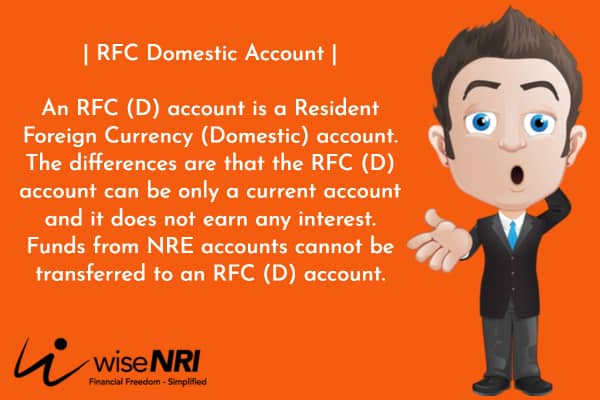
| Feature | RFC | RFC (Domestic) |
|---|---|---|
| Who it is for | Returning NRIs | Any resident |
| Account type | Savings, current or term deposit | Current account only |
| Interest | Yes | None |
| Funding from NRE or FCNR | Yes | No |
| Typical use | Parking a life’s savings after return | Leftover forex from travel, honorarium, gifts |
Opening It: The Short Version
You will need the account opening form, a self-attested passport copy showing your immigration stamps, a copy of the work visa or permit you held abroad, proof of your Indian address, and PAN. Some banks ask for proof of the one-year stay abroad, which the visa usually satisfies.
You can hold it singly, or jointly with a resident relative on a former or survivor basis. The relative cannot operate the account while you are alive.
What the conversion actually cost
Anil’s bank converted 340,000 dollars at a rate about 45 paise below the interbank level that morning. That spread alone was roughly Rs 1.5 lakh, gone in one transaction. Add the fact that he then had to send about 60,000 dollars back to Boston across the next two years, paying a second spread on the way out, and the total friction came close to Rs 2.4 lakh. An RFC account would have cost him nothing to hold it and paid him interest while he waited.
Returning NRIs think hard about where to invest and almost never about which currency to be in while they decide.
Loss Aversion and the Rupee Reflex
Loss aversion is our tendency to feel a loss roughly twice as sharply as an equivalent gain. Watching a dollar balance sit still while the rupee moves feels like bleeding, so people convert to make the discomfort stop.
But converting does not remove risk. It swaps one currency risk for another. If your daughter’s tuition, your travel, or your possible return abroad are all in dollars, then holding rupees is the risky position, not the safe one.
Match the currency to the future spending, not to the number that makes you calmer today.
Moving back to India in the next year or two?
The decisions you make in your first ninety days set your tax bill for the next three years.
Questions Returning NRIs Ask Me
Is RFC interest tax free?
Only while you hold RNOR status. After that it is taxable at your slab rate like any other interest.
Can I keep the account forever?
Yes, the account itself continues. It just stops being tax efficient once RNOR ends, so most people convert or redeploy around then.
Can I move money from RFC back into NRE?
Yes, if you become a non-resident again. That flexibility is one of the main reasons to use it.
Do I need to close my NRE account when I return?
It must be redesignated. Talk to your bank before you land, not after. The full return checklist is here.
Is there a limit on how much I can hold?
No upper limit, and the balance is fully repatriable.
Where should the money eventually go?
That depends on when you actually need it and in which currency. Start with the options available to you here.
Coming home is rarely one clean moment. Part of your life stays behind for a few more years, in a currency you still need. An RFC account is simply the bank’s way of admitting that.
You do not have to convert everything just because you landed.
💬 Your Turn
If you have returned to India already, how much of your foreign currency did you convert in the first month, and would you do it the same way again?


I’m a resident of India and earn in USD through a remote job, Can I open the account?
Hi Farheen,
As an Indian resident You cannot open an NRI/NRO account but you can open a Resident Foreign Currency account or hold a regular savings account and convert your USD earnings through authorized channels.
Rfc account can l open l live in uk
Hi Karan,
Yes, living in the UK, you can open and maintain an RFC account in India.
I am looking for resident foreign currency account openings….process
I am holding a RFC account term deposit which is matured after 3 years period. Can I renew the same in same currency. Now I am a resident
Hey Karan,
Yes, as a resident, you can renew your RFC (Resident Foreign Currency) account term deposit in the same currency after it has matured. RFC accounts are designed for residents who have returned to India after being an NRI. When your RFC term deposit matures, you can choose to renew it for the same or a different duration, and you can also maintain it in the same currency as before.
what is the difference between RFC and RFC (D) account with example
Hi Ravish,
The differences are that the RFC (D) account can only be a current account and it does not earn any interest.
what is the difference between resident foreign currency (domestic) account and resident foreign currency account?
Hi Harshi,
The differences are that The Resident Foreign Currency (Domestic) account can only be a current account and it does not earn any interest.
How long one can maintain RFC deposit in Bank after NRI becomes resident
Hi Mady,
As per my knowledge you can maintain it for 2-3years.
After returning to India, let us say in Dec 2022, when do we cease to be an NRI?
Hi Jaya varghese
It is usually 2 years and rest it depend upon your earlier visits.
Can an NRI son gift his father in foreign currency outside India to purchase a house property outside India? What are the FEMA implications?
Hi Bishwajit,
Yes he can.for FEMA implications he should consult with a CA.
How can I transfer money from a account in India owned by a resident of India to a NRI living in the UK with minimum tax? I have looked at gifts, NRE,NRO, RFC, please help… The NRI has a NRE and NRO account. The sum being transferred is 50,000 pounds equivalent.
Hi Kani
If the NRI is your relative then you can transfer it with a gift deed. If not a relative then you have to pay taxes
NRE deposit held in INR can it be transferred to RFC account?
Hi Suneet,
As per my knowledge, the NRE account can be converted into an RFC account.
As a resident savings account customer ,can i open a foreign currency account or RFC account? i was never an NRI.
Hi Ram,
As per my knowledge, You can’t open the respective account.
I wanna be how what I do to receive an account to use in RFC SAP ECC?
Hi Pedro,
You should consult with your bank regarding this.
I have NRE savings account jointly held with my wife. My status has been changed from NRI to resident Indian but my wife is still an NRI. I am primary holder of the account. Can i change this account to RFC account and how.
Hi Ashish,
Yes you have to change this account to RFC.you should consult with your bank for this.
I returned India on 4th October after 33yrs staying in Saudi Arabia ..I need investment and tax consultation with you pls advise how will I proceed
Sure Dr Masood – we will get in touch with you.
Thanks for your nice article..How long a returning NRI can maintain the RFC accounts? Is it life long or for some limited years?
Very good and pertinent question. Could some person please answer this question.
Hi Amit,
NRI Can maintain the RFC account maximum 3 years.
Thanks Sanjoy…But I am not sure about your reply..As far as I know, during RNOR status of maximum 3 yrs, RFC account interest is tax free and afterwards it is treated as a Domestic RFC account , thus interest becomes taxable in India and can be maintained for a indefinite time…Please check and confirm/revert…
Waiting for your feedback…A. Dutta
Useful reading. Being NRI, I become enriched with this article.
Thanks Shyamal 🙂
A NRI for 25 years returning to India having USD FCNRs and NRE Rs deposits.
1. What should be done with NRE InRs deposits ? Can they be retained till maturity? Is the interest taxable or taxfree?
2. What should be done with USD FCNRs? Can they be retained till maturity? Is interest taxfree?
3 For InRs NRE account – is it to be converted to RFC account?
Thanks NM
Hi. NM
1. Yes, you can retain those till maturity and interest will be tax -free.
2. Yes, you can also hold USD FCNR till maturity and interest will be tax-free.
3. Yes
Please refer for more info. https://www.wisenri.com/nre-fd-after-return-to-india